internals · 2 of 6 · handles
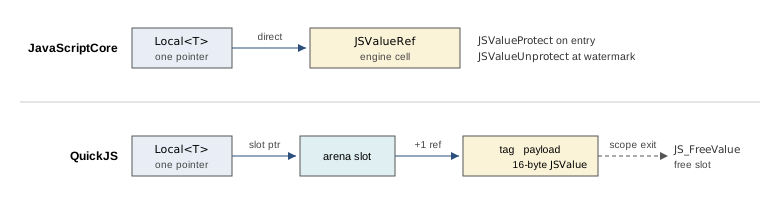
Both backends expose the same pointer-shaped Local<T>. They keep that promise in very different ways.
JSValueRef is already a pointer, so it is used directly. Protect the value, remember it, unprotect at scope exit:
// intern
JSValueProtect(ctx, v);
iso.locals.push((v, ctx));
return v as *const T;

// HandleScope::drop: pop to the watermark saved at scope entry
while iso.locals.len() > scope.watermark {
    let (v, ctx) = iso.locals.pop();
    JSValueUnprotect(ctx, v);
}A JSValue is 16 bytes of payload and tag, so the bits cannot themselves be a pointer. Each value moves into a boxed arena slot and the slot address becomes the handle. Every slot owns exactly one reference count:
// fresh engine result: move it into the slot
fn intern_fresh(v: JSValue) -> Local<T>    { arena.push(slot(v)) }
// borrowed value: take our own count first
fn intern_borrowed(v: JSValue) -> Local<T> { arena.push(slot(JS_DupValue(ctx, v))) }

// HandleScope::drop
while arena.len() > scope.watermark {
    JS_FreeValue(ctx, arena.pop().value);
}
Duplicating a fresh value would leak a reference. Moving a borrowed one would free a value some other owner still holds. The one-count-per-slot rule prevents both.
// JSC: same pointer, protection-counted in a side map
protect_count[(v, ctx)] += 1;                                  // Global::new
if --protect_count[(v, ctx)] == 0 { JSValueUnprotect(ctx, v); } // Global::drop

// QuickJS: first field is a JSValue, so &cell.value doubles as a Local
struct PersistentCell { value: JSValue, ctx: *mut JSContext, iso: *mut IsoState }QuickJS keeps a native WeakRef next to the persistent cell, sweeps after JS_RunGC, and fires the Rust callback for dead targets. JSC’s public C API has no per-object weak reference, so that backend records callbacks and drains them after an explicit collection request.
Handle validity is exact on both backends. Collection timing is not: a reference count reaching zero, a cycle pass, a tracing collection, and a V8 major GC are four different events, and v8x does not pretend otherwise. Code that depends on finalizer order stays engine-sensitive.